
AI is getting better at doing the work, not just answering questions
For the last couple of years, businesses have been asking a fairly simple question:
“What can AI do for us?”
That question is starting to change.
Now, the more useful question is:
“What work can we safely hand over to AI?”
That difference matters.
In September 2026, several developments across the AI industry have pointed in the same direction: businesses are moving beyond chatbots and experiments and are looking at AI systems that can actually perform tasks, interact with business systems and work toward specific outcomes.
Salesforce, for example, announced a new portfolio of job-ready AI agents designed for areas including sales, customer service, commerce and employee experience. The company says its latest Agentforce capabilities are designed to allow agents to pursue goals over longer periods, learn skills and work with other agents.
At the same time, UiPath’s latest enterprise survey highlights the other side of the story: many companies have started experimenting with agentic AI, but are struggling to move those projects from proof-of-concept to meaningful production deployments.
And honestly, that may be the most important part of the story.
The AI industry isn’t struggling to demonstrate what AI could do.
The challenge is turning it into something that actually works inside a business.
From chatbots to AI agents
Traditional chatbots are relatively straightforward.
A customer asks:
“Where is my order?”
The system finds the relevant information and responds.
Useful? Absolutely.
But an AI agent can potentially take that process further.
For example:
- Understand the customer’s request.
- Identify the customer’s order.
- Check the delivery status.
- Identify a delay.
- Check the company’s delivery policy.
- Decide what action is allowed.
- Send the customer an update.
- Escalate the case if human involvement is required.
- Record the interaction in the CRM.
The important difference is that the AI isn’t simply generating an answer.
It’s participating in a workflow.
That’s where AI agents become particularly interesting for businesses.
The real opportunity is not “more AI”
This is where businesses need to be careful.
It’s easy to get excited about having dozens of AI agents.
But having 20 agents doesn’t automatically mean a company is more efficient.
A recent discussion around workplace AI agents highlighted exactly this problem: the number of agents a company has isn’t necessarily a meaningful measure of success. What matters more is whether those agents are solving useful problems and producing measurable outcomes.
Imagine a company saying:
“We have deployed 50 AI agents.”
That sounds impressive.
Now ask:
“What did those agents actually improve?”
That’s the better question.
Did they:
- reduce response times?
- qualify more leads?
- reduce manual data entry?
- schedule more appointments?
- process documents faster?
- improve customer response rates?
- reduce repetitive administrative work?
If the answer is no, the number of agents doesn’t really matter.
Agentic AI needs workflows, not just intelligence
This is probably the biggest lesson businesses should take from the current AI market.
An intelligent model by itself isn’t a business automation strategy.
The model needs:
Data + tools + permissions + business rules + workflow + monitoring + human oversight
That combination is what turns AI capability into something useful.
For example, consider lead management.
A basic AI chatbot might answer questions about a company’s services.
An AI workflow automation system could go much further:
Website visitor → AI conversation → qualification → CRM entry → lead scoring → follow-up → appointment booking → sales notification
Now AI isn’t sitting separately from the business.
It is connected to the process.
That’s a much more valuable use of AI.
Why many AI projects are still stuck in the pilot stage
UiPath’s September 2026 survey of nearly 600 enterprise technology leaders found that many organizations have proof-of-concept agentic AI deployments but are struggling to scale them and achieve meaningful ROI. The company points to orchestration as an important part of moving deployments forward.
This makes sense when you look at what happens inside a real company.
A demo might work perfectly.
But production is different.
A real business has:
- multiple software systems
- messy data
- different user permissions
- approval processes
- compliance requirements
- exceptions
- customers who don’t behave predictably
- employees who need visibility into what AI is doing
That’s why an AI agent that works beautifully in a demo can become much harder to operate at scale.
The next step isn’t full autonomy
There’s a temptation to think the future is:
Human → AI takes over everything
That’s probably the wrong way to think about it.
A better model is:
Human + AI + controlled automation
Some tasks can be fully automated.
Others should require approval.
And some decisions should remain completely human.
For example:
| Business task | Possible AI role |
|---|---|
| Answering common questions | Automated |
| Lead qualification | AI-assisted / automated |
| Appointment scheduling | Automated |
| Invoice data extraction | Automated |
| Refund approval | Human approval |
| Legal decision | Human-led |
| High-value financial transaction | Human approval |
The level of autonomy should depend on the risk and importance of the decision.
That is one reason the current shift toward governed agentic systems is important. For example, Esker’s September 2026 launch of its Synergy Agentic Framework emphasizes autonomous execution alongside permissions, business rules, approvals and auditability.
In other words:
Let AI move quickly where the risk is low. Put humans in control where the consequences are high.
What businesses should automate first?
If you’re a business owner looking at all of this and wondering where to start, don’t begin with:
“Where can we use AI?”
Start with:
“Where are our people repeatedly doing the same work?”
Look for processes involving:
1. Repetitive customer conversations
FAQs, appointment requests, order updates, basic support questions and lead enquiries are often good starting points.
2. Manual lead management
If employees are copying information from forms, emails or WhatsApp conversations into a CRM, there’s probably an automation opportunity.
3. Appointment scheduling
AI can potentially handle availability checks, reminders, rescheduling and basic qualification before involving a person.
4. Document-heavy processes
Invoices, applications, forms, and reports can create huge amounts of repetitive work.
UiPath has also highlighted intelligent document processing as an important foundation for making business information usable in automated and agentic workflows.
5. Reporting and business intelligence
Instead of employees manually collecting information from several systems every week, AI can help bring that information together and surface useful changes.
The biggest mistake businesses can make
The biggest mistake isn’t not adopting AI fast enough.
It’s adopting AI without understanding the process it’s supposed to improve.
Suppose a company’s sales process is already complicated.
Adding an AI agent on top of that complexity won’t necessarily solve the problem.
It might simply automate a broken process.
Before implementing an agent, businesses should ask:
What is the current process?
Where does the information come from?
What systems need to communicate?
What decisions can AI make?
What decisions require approval?
What happens when the AI is uncertain?
How will success be measured?
These questions aren’t as exciting as an AI demo.
But they’re much more important when you’re trying to build something that works in the real world.
What September 2026 tells us about the future of AI
The recent developments from companies such as Salesforce, UiPath and Esker point toward an interesting shift.
AI is gradually moving from:
“Ask AI something.”
to:
“Give AI a job.”
That’s a much bigger change.
The future of business AI may not be about having one enormous AI system that does everything.
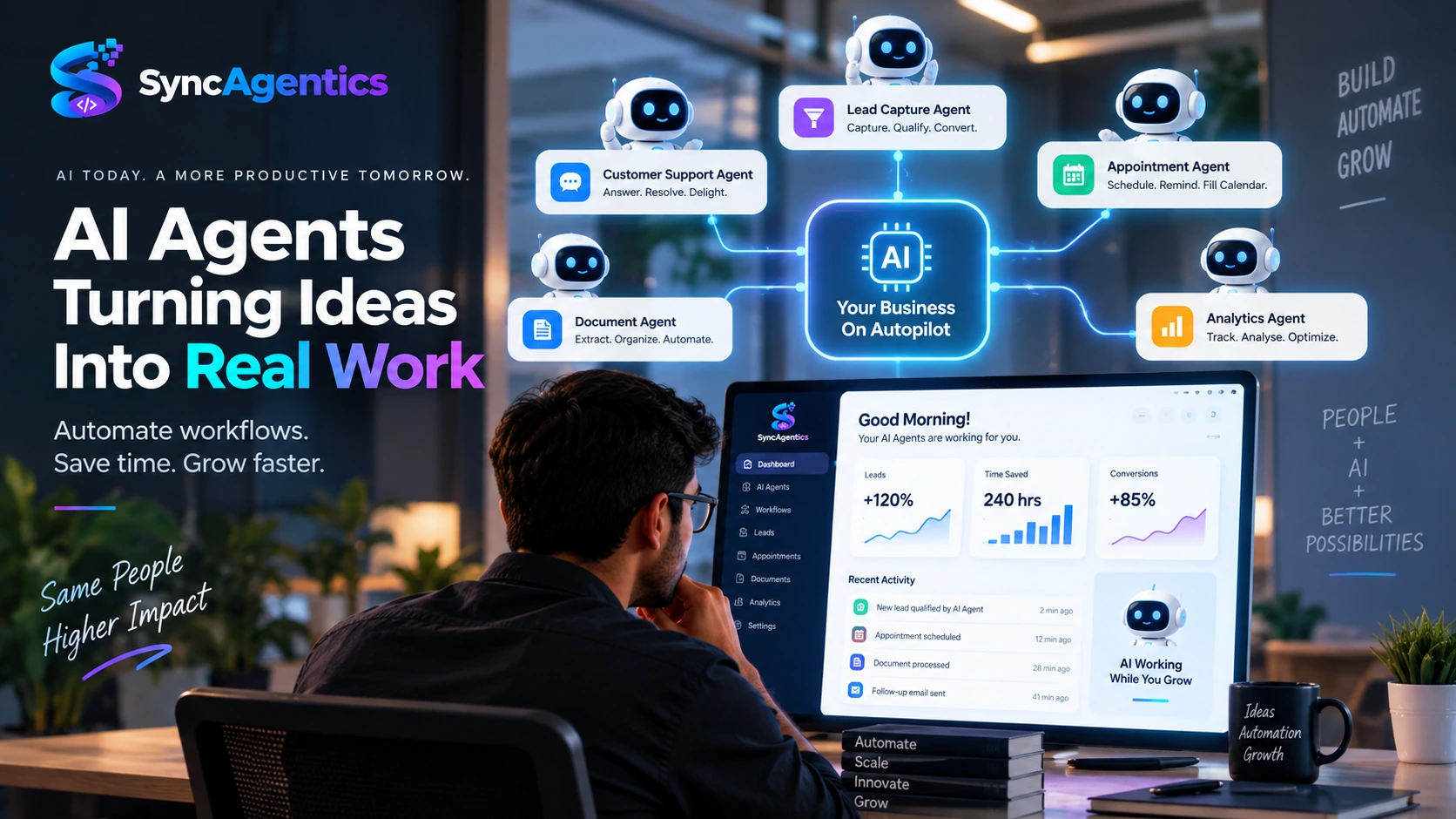
Instead, companies may use specialized agents connected to specific workflows, systems and business rules.
One agent might handle customer enquiries.
Another might qualify leads.
Another might process documents.
Another might monitor business data.
And another might coordinate activities between systems.
But the real value will come from how those pieces work together.
That’s where agentic AI and AI workflow automation start becoming more than buzzwords.
What this means for small and mid-sized businesses
You don’t need a huge enterprise AI department to benefit from these developments.
In fact, smaller businesses may have an advantage in some cases.
If a company has a relatively simple workflow, it can potentially identify one repetitive process and automate it without rebuilding its entire technology stack.
For example:
Website → AI lead qualification → CRM → follow-up → appointment
is a much more practical starting point than trying to automate the entire company.
Start small.
Measure the result.
Fix the weak points.
Then expand.
That’s a much healthier approach than deploying AI everywhere simply because the technology is available.
The AI winners won’t necessarily have the most agents
This is probably the biggest takeaway from the current market.
The companies that benefit most from AI won’t necessarily be the companies with the largest number of AI agents.
They’ll be the companies that know:
which processes to automate,
where AI should make decisions,
where humans should remain involved,
and
how to connect AI to the systems the business already uses.
The technology is moving quickly.
But good automation still starts with a simple question:
What problem are we actually trying to solve?
And that’s a question that won’t become outdated anytime soon.
Final takeaway
The latest AI developments suggest that the industry is entering a more practical phase.
The conversation is shifting from AI that can generate to AI that can act.
But action without control isn’t automation — it’s risk.
Businesses that approach AI agents, agentic AI, and AI workflow automation with clear processes, measurable goals, and appropriate human oversight are likely to get much more value from the technology than those simply chasing the latest AI trend.
The future isn’t about replacing every person with an AI agent.
It’s about giving people better systems to work with.
And that may be the most useful version of the AI revolution yet.
Sources
- Salesforce, September 14, 2026 — Agentforce expansion and job-ready AI agents.
- UiPath, September 9, 2026 — Enterprise survey on scaling agentic AI and orchestration.
- Esker, September 9, 2026 — Synergy Agentic Framework for governed finance automation.
- UiPath, September 14, 2026 — Intelligent document processing and agentic workflows.